The Railway Recruitment Board (RRB) conducts the Non-Technical Popular Categories (NTPC) recruitment examination for various undergraduate and graduate-level posts in Indian Railways. Candidates who are preparing for the RRB NTPC examination should understand the complete selection process and exam pattern before starting their preparation.
The RRB NTPC selection process generally includes Computer Based Tests (CBT-1 and CBT-2), followed by a post-specific skill test where applicable, Document Verification and Medical Examination. CBT-1 is primarily a screening examination, while CBT-2 plays an important role in shortlisting candidates for the subsequent stages.
RRB NTPC Exam Pattern Overview
| Particulars | Details |
|---|---|
| Recruitment Organization | Railway Recruitment Boards (RRBs) |
| Exam Name | RRB NTPC |
| Full Form | Railway Recruitment Board Non-Technical Popular Categories |
| Exam Mode | Computer Based Test (CBT) |
| CBT Stages | CBT-1 & CBT-2 |
| Question Type | Objective Type Multiple Choice Questions |
| Negative Marking | 1/3 Mark for each wrong answer |
| CBT-1 Duration | 90 Minutes |
| CBT-2 Duration | 90 Minutes |
| Selection Stages | CBT-1, CBT-2, Skill Test where applicable, DV & Medical |
RRB NTPC CBT-1 Exam Pattern
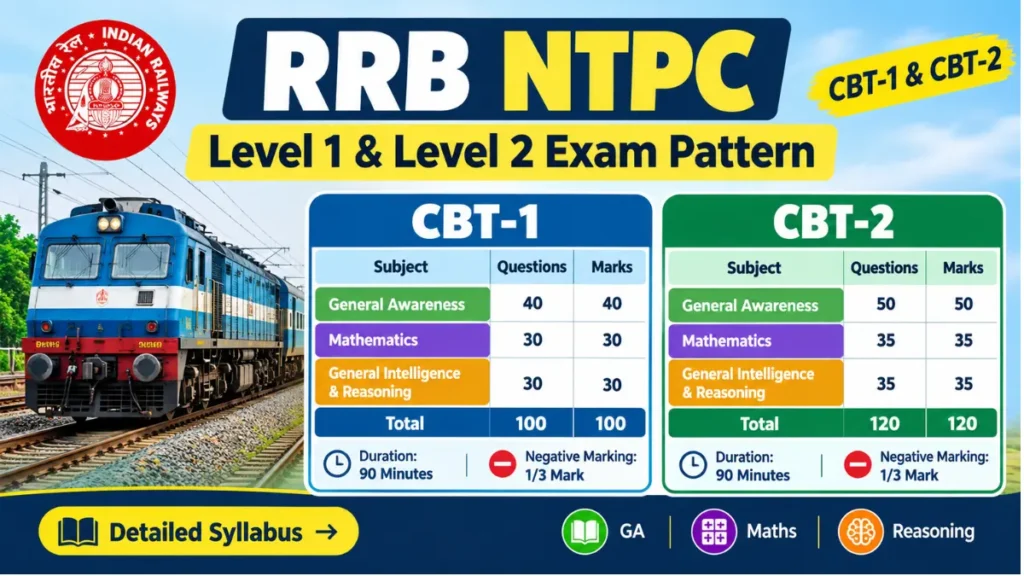
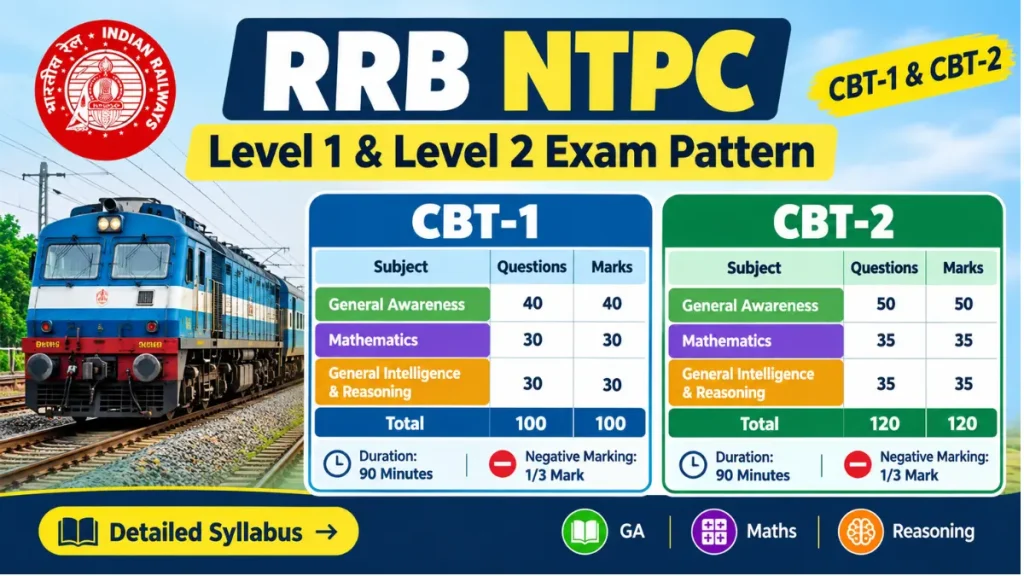
The first stage of the RRB NTPC examination is CBT-1. It consists of 100 objective-type questions carrying a total of 100 marks. Candidates are given 90 minutes to complete the examination.
| Subject | Questions | Marks |
|---|---|---|
| General Awareness | 40 | 40 |
| Mathematics | 30 | 30 |
| General Intelligence & Reasoning | 30 | 30 |
| Total | 100 | 100 |
CBT-1: 90 Minutes | 100 Questions | 100 Marks | Negative Marking: 1/3 mark for every incorrect answer.
RRB NTPC CBT-2 Exam Pattern
Candidates shortlisted through CBT-1 are eligible to appear for CBT-2. The second stage contains 120 questions for a total of 120 marks, with a duration of 90 minutes.
| Subject | Questions | Marks |
|---|---|---|
| General Awareness | 50 | 50 |
| Mathematics | 35 | 35 |
| General Intelligence & Reasoning | 35 | 35 |
| Total | 120 | 120 |
CBT-2: 90 Minutes | 120 Questions | 120 Marks | Negative Marking: 1/3 mark for every incorrect answer.
RRB NTPC Selection Process
The selection process may vary according to the post. Generally, candidates have to qualify CBT-1 and CBT-2, followed by a Computer Based Aptitude Test (CBAT) or Typing Skill Test for applicable posts. Candidates who qualify all the required stages are called for Document Verification and Medical Examination.
Selection Stages:-
- Written Exam (Tier-I + Tier-II)
- Skill Test (as per post recruitment)
- Documents Verification
- Medical Test
RRB NTPC Detailed Syllabus
The RRB NTPC syllabus is mainly divided into three subjects: General Awareness, Mathematics, and General Intelligence & Reasoning. The syllabus is broadly similar for CBT-1 and CBT-2, although the number of questions and marks differs.
RRB NTPC Mathematics Syllabus
The Mathematics section tests candidates on basic arithmetic, algebra, geometry and quantitative aptitude. Important topics include:
- Number System
- Decimals and Fractions
- LCM and HCF
- Ratio and Proportion
- Percentage
- Profit and Loss
- Simple Interest and Compound Interest
- Time and Work
- Pipes and Cisterns
- Time, Speed and Distance
- Mensuration
- Elementary Algebra
- Geometry
- Trigonometry
- Elementary Statistics
- Average
- Age Problems
- Partnership
- Data Interpretation
- Simplification
- Square Root
- Problems on Boats and Streams
- Calendar and Clock
RRB NTPC General Intelligence & Reasoning Syllabus
This section evaluates the candidate’s logical thinking, analytical ability and problem-solving skills. The important topics are:
- Analogies
- Number Series
- Alphabetical Series
- Coding and Decoding
- Mathematical Operations
- Similarities and Differences
- Relationships
- Syllogism
- Venn Diagrams
- Puzzle
- Statement and Conclusion
- Statement and Assumption
- Analytical Reasoning
- Data Sufficiency
- Decision Making
- Classification
- Blood Relations
- Direction Sense Test
- Ranking and Ordering
- Missing Number
- Jumbling
- Maps
- Interpretation of Graphs
- Conclusions and Inferences
- Non-Verbal Reasoning
RRB NTPC General Awareness Syllabus
General Awareness carries the highest number of questions in both CBT-1 and CBT-2. Candidates should cover both static GK and current affairs.
Current Affairs
- National and International Current Affairs
- Important Government Schemes
- Sports News
- Awards and Honours
- Books and Authors
- Important Appointments
- Important Days
- Science & Technology Updates
- Defence News
- Railway-related Current Affairs
- Important National and International Events
General Science
- Physics
- Chemistry
- Biology
- Basic Science and Scientific Developments
- Everyday Applications of Science
History
- Ancient Indian History
- Medieval Indian History
- Modern Indian History
- Indian Freedom Struggle
- Important Historical Events
- Important Personalities and Movements
Geography
- Indian Geography
- World Geography
- Physical Geography
- Rivers and Mountains
- Climate
- Natural Resources
- Agriculture
- Transport and Communication
- Important Geographical Locations
Indian Polity
- Indian Constitution
- Fundamental Rights
- Fundamental Duties
- Directive Principles of State Policy
- Parliament
- President and Vice-President
- Prime Minister and Council of Ministers
- Supreme Court and High Courts
- Constitutional Bodies
- Elections
- Panchayati Raj
- Local Government
Indian Economy
- Basic Economics
- Indian Economic System
- Banking and Financial System
- Budget
- Taxation
- Inflation
- GDP
- Economic Planning
- Government Economic Schemes
- Important Economic Terms
Computer Awareness
- Basics of Computers
- Computer Hardware and Software
- Operating Systems
- MS Office
- Internet
- Computer Networks
- Input and Output Devices
- Memory and Storage
- Computer Abbreviations
- Cyber Security
- Basic Computer Terminology
Miscellaneous General Knowledge
Indian Art and Culture, Indian Literature, Famous Personalities, Monuments and Places, Important Organizations, UN and International Organizations, Environmental Issues, Flora and Fauna, Transport Systems in India, Famous Inventions and Inventors, Important Government/Public Sector Organizations.